
…in-situ at the Ministry of Casual of Living
In January 2025, the Ministry of Casual Living put out a call for artworks using paper, inviting artists to come to the space and make art in community, or drop off work already made.

I was intrigued by the invitation, and thought about all the papers I had in my apartment, and wondered which I most wanted to be rid of. The legal papers following my journeys through British Columbia’s Residential Tenancy Branch immediately came to mind, and I chose a stack served to me by my former landlord’s lawyer, who – using a loophole in the Residential Tenancy Act – had successfully evicted me for landlord’s use of property. In that case, “landlord’s use” meant gifting their son – as a wedding present – an empty apartment, not to live in, but rather to rent out at higher monthly rate than I was paying.
Wanting to transform that energy, I took the stack of papers and a stainless steel bowl to the Ministry of Casual Living and installed myself in the designated work space – a table and chairs, set up in the large entryway beside the side door, at the end of the main hall.
I sat there and started tearing my papers into thin strips about an inch wide. Chatting with whatever artists stopped by, each working in their own unique way. One who stapled pieces of construction paper all over another piece of construction paper, one who coloured with wax crayons old black and white images, another who made clever tongue-in-cheek social commentary with a combination of illustration and paper collage. So it was not only an art-making activity, in-situ, but also a community building opportunity even if I was the only one systematically transforming legal eviction papers.
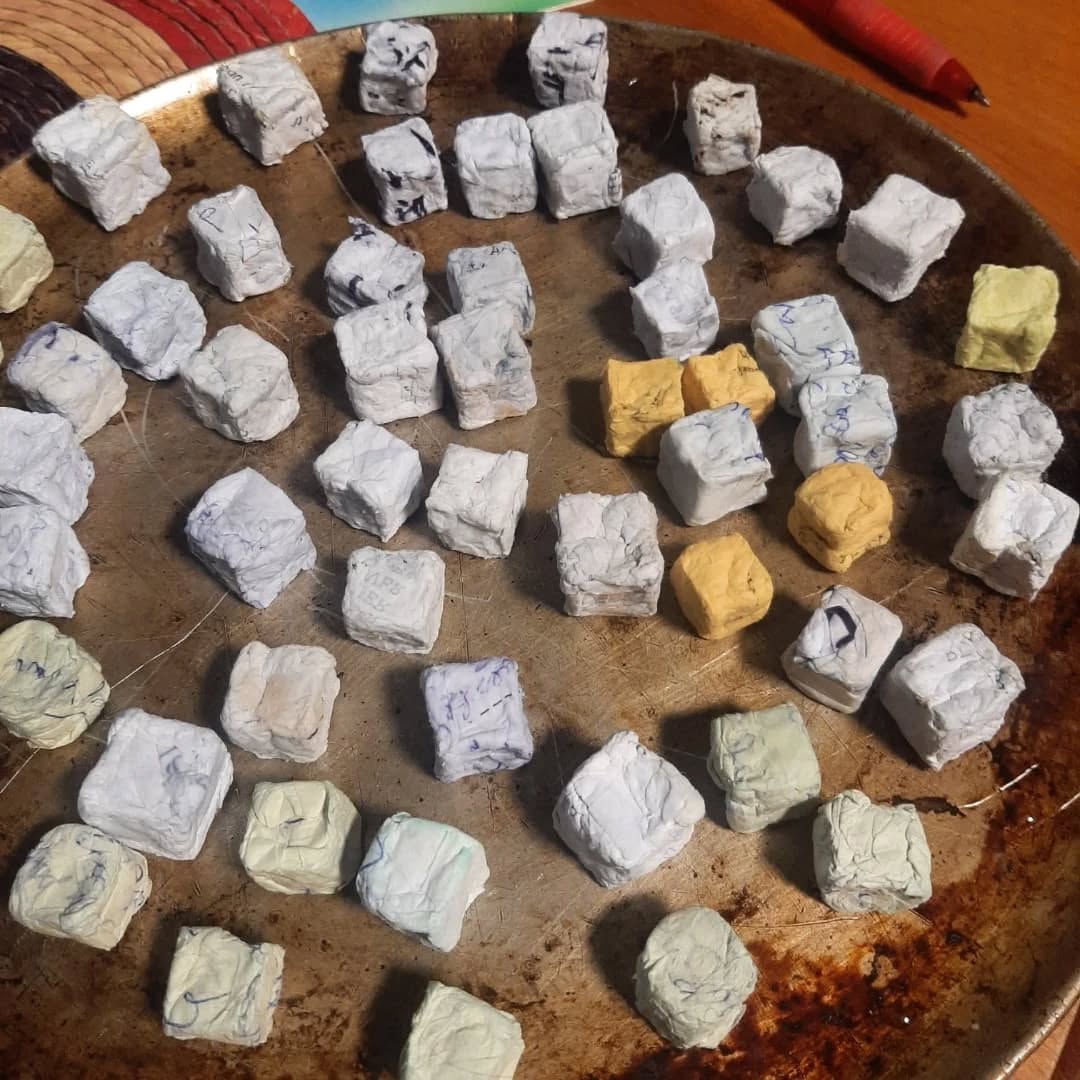
When I had a pile of paper strips, I filled my stainless steel bowl with plain water, and dipped each strip, one by one into the clear liquid, then using forefinger and thumb, molded the wet strips into little paper bricks. After each session, I’d leave my collection of bricks to dry. I wasn’t sure what I was going to make. I thought maybe I’d build small houses from the bricks.
Building Art on Another Artist’s Discarded Artwork: A Topographical Map Emerges

While I was working, someone left a collection of paintings on the lawn adjacent to the Ministry of Casual Living — work an artist had left in the basement of a rental they’d vacated. After confirming the artist didn’t want to artworks, the landlord brought them over and left them for anyone to take. Every piece was taken but one: a large painting of a rooster with some vague, seemingly disembodied human heads in one corner. It was, frankly, a pretty bad painting. And yet I was drawn to it. And as my mixed-media collage practice often involves building on pre-existing art works – usually discarded pieces I find in random places – I grabbed the roughly meter by meter and a half painting to use as a base for my paper cubes.
It just sat there in the room for a couple sessions, leaning against the wall where I could see it, while I continued tearing and moulding strips of legal eviction papers into building blocks. As the project progressed, fewer artists came by and I often found myself sitting there working in solitude.
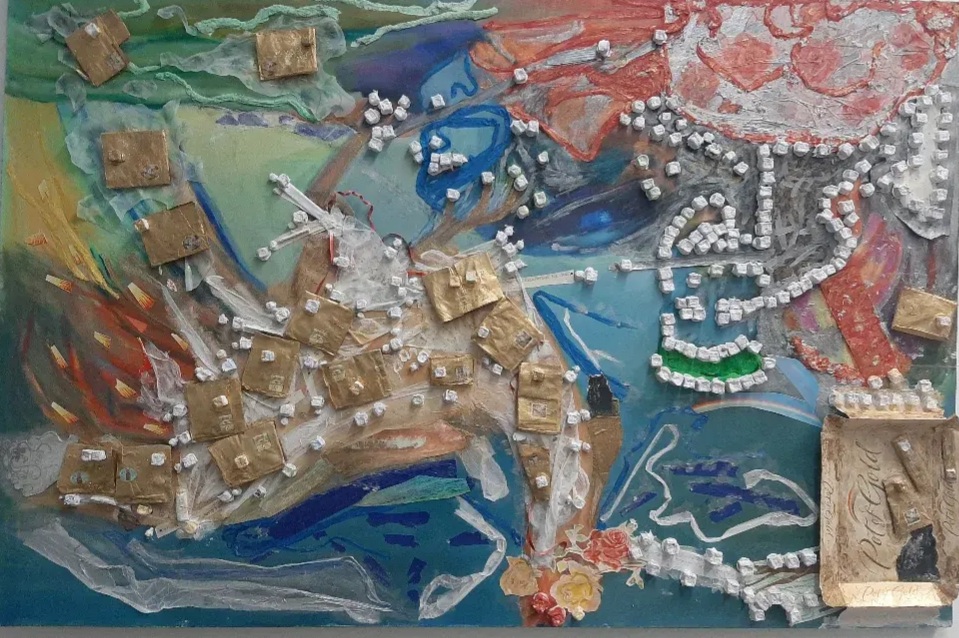
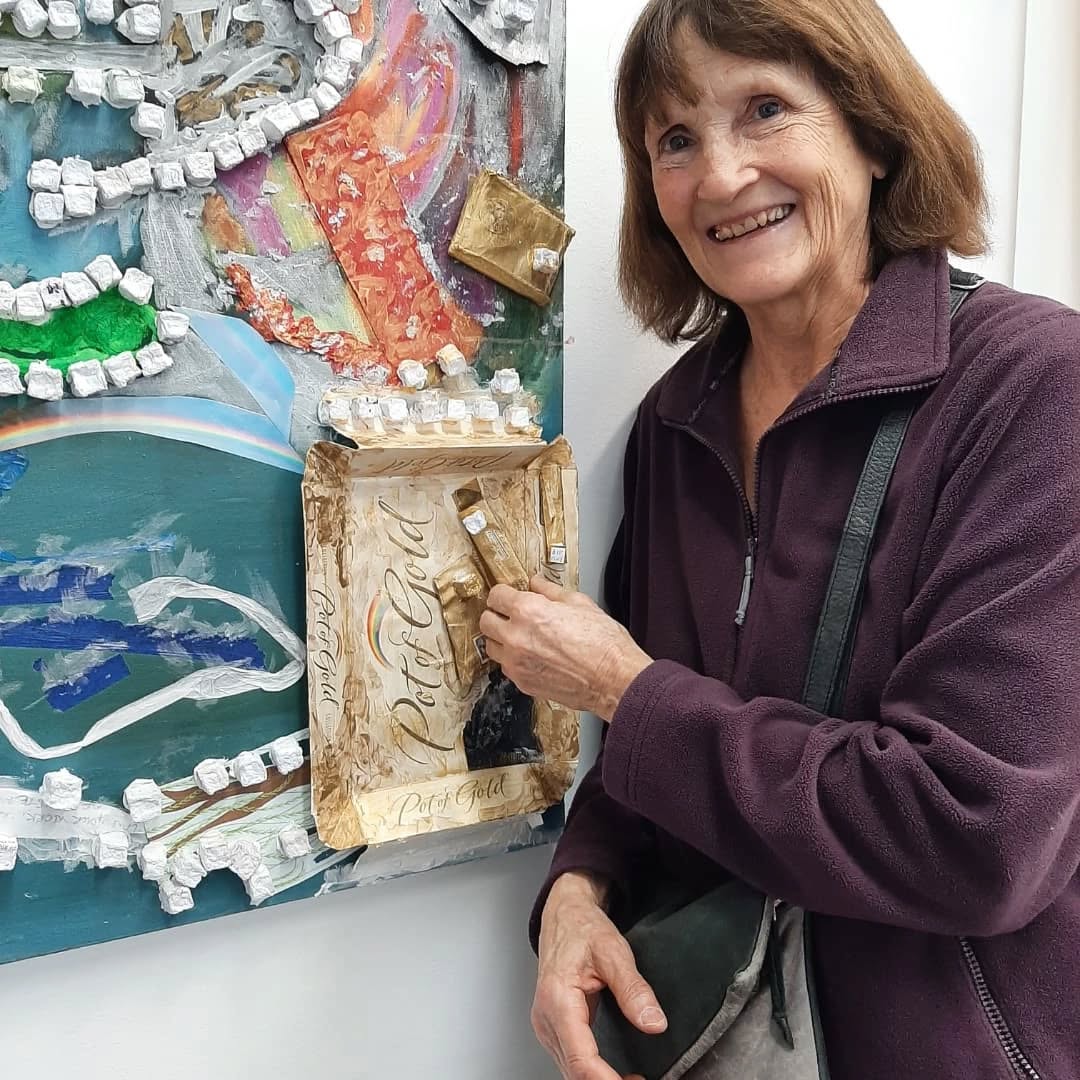
Finally, I was inspired to start building on the salvaged, discarded canvas. Using acrylic matte medium, I attached my paper bricks, and other paper artifacts I’d brought in to work with – including an old Pot of Gold chocolate box that had some paper bits, made, but not used for a Red Thread project done several years previously.
I arranged my paper blocks to follow the outlines of the painted figures while simultaneously obscuring them. At this stage the piece was oriented vertically — taller than wide, standing upright against the wall — still very much in process.
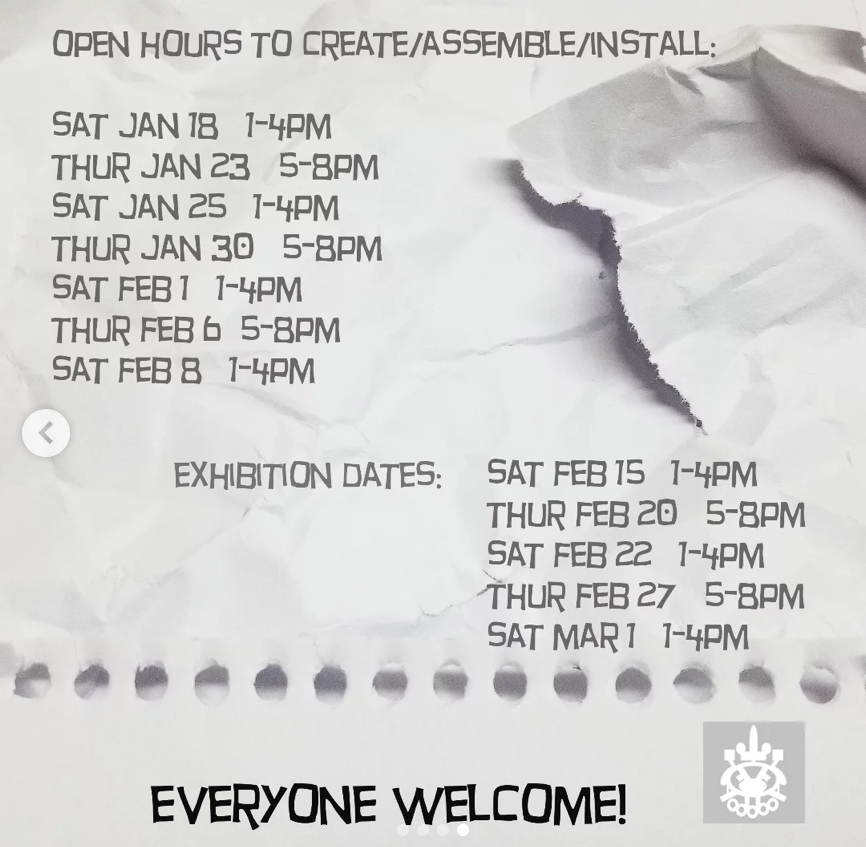
The construction process was eight sessions over four weeks, with access to the arts facility one evening a week and Saturday afternoons, with some additional work done at home.
As the piece evolved, I started to work on it horizontally, laid flat across the table. As the opening day drew closer, more artists started showing up to drop off work they’d made at home. Some would stop and look, as would artists going to their studios in the building. Several asked the same question: was this a topographical map? Was it a map of Victoria?
I hadn’t planned that. But something in the layered paper bricks, shaped by the contours of the discarded image, had created the impression of land — of territory.

Gold Fridge Magnets: A House on a Plot of Land
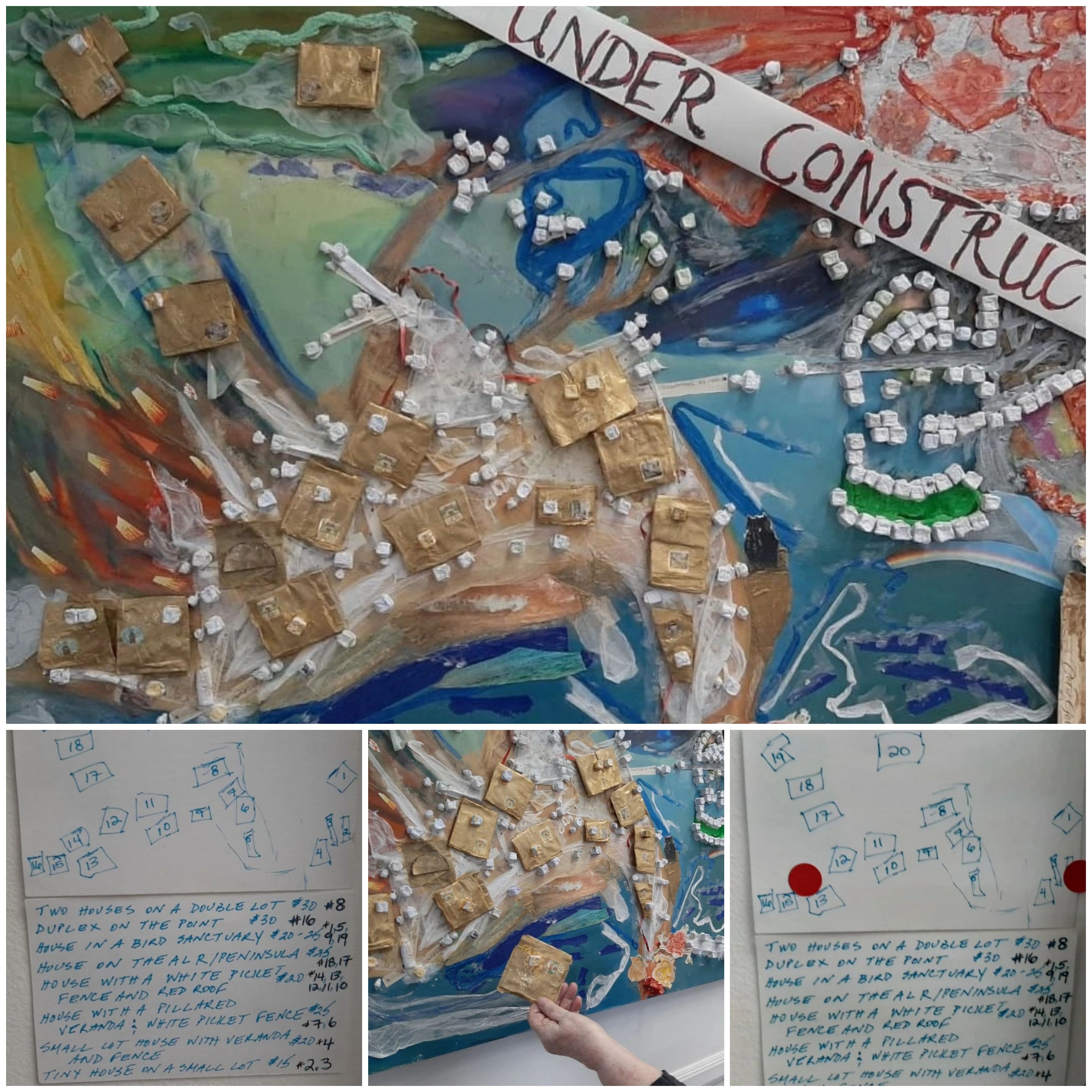
The fridge magnets came next. I took small squares of paper, folded them flat, and inserted a magnet inside each one. Then spray-painted them gold. On the face of each gold square I glued a sticker depicting a house, and one of my paper bricks — the same bricks I’d made from my torn eviction papers. I attached pieces of metal to the main artwork so the golden magnetic squares could stick to it, then be sold, removed, and taken home to live as a fridge-magnet.
A friend with real estate knowledge created a guide specifying exactly what each magnet represented in the housing market — a single dwelling on agricultural land, a duplex, a bungalow with a white picket fence. For ten to twenty, even thirty dollars you could buy one of these paper magnets and become a landowner. I sold two.
Audience Feedback Sparks Ideas
Visitors suggested the gold squares could be envelopes they could open and find something inside. A land deed. A housing story or poem. Some sort of housing experience, in a hand-made golden envelope that doubles as a magnet… available for ten to thirty dollars each.
That idea is still alive. Pot of Gold 2.0 would include an invitation for community members to bring their housing stories — to write them out, or create a collage, maybe a performance, drawing on games used in Theatre of the Oppressed, and creative modalities.
Pot of Gold connects to an earlier project I’d started just before the pandemic, when I received a City of Victoria My Great Neighbourhood Grant to run a series of Theatre of the Oppressed workshops through community centres across the region — gathering housing stories through playback theatre, building toward a company of players who would perform for landlords, realtors, and property managers. COVID ended that project before it began. Though I did pivot it to a community soup chain feeding the unhoused population sheltering in Beacon Hill Park during the pandemic. I recruited over twenty-five households taking turns to make and deliver a pot of soup to the Meegan Community Care Tent on Cook Street.
Then I got a small grant from City of Victoria Arts to buy art supplies to distribute to the unhoused, and pay unhoused and housed persons a stipend to share art making skills.
Pot of Gold is in many ways a continuation of that housing work.
Housing trauma, and access to safe, secure housing is an on-going problem here in Victoria, British Columbia, Canada where a house on a plot of land, is indeed, a Pot of Gold.


Leave a Reply