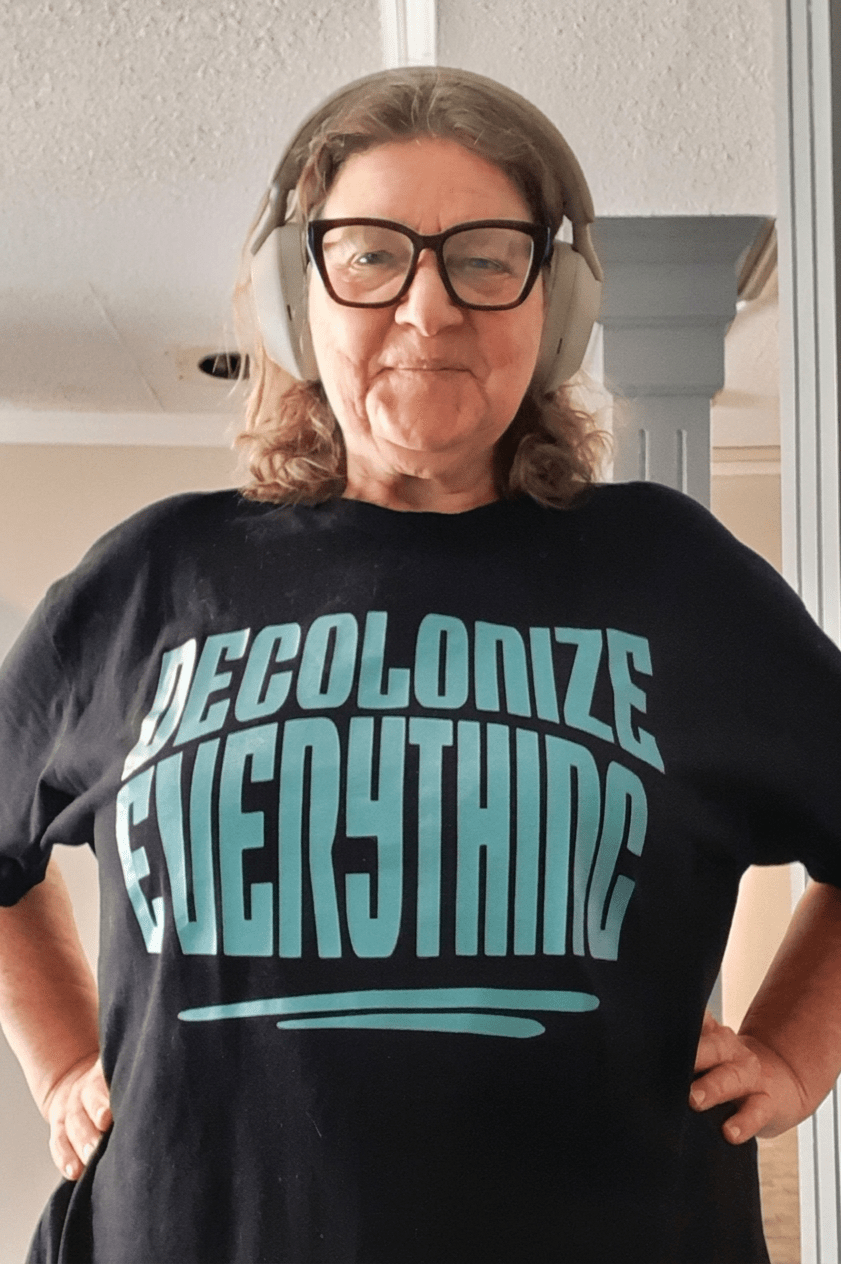
For the C word in my Oppressor Alphabet journey, I’ve spent the last two weeks mulling over colonialism and coloniality. Who’s impacted by it, who’s implicated? What’s the difference?
Early in the process, I woke up in the middle of of the night and wrote a memoir about my Cree friend, the late Lyle Jacob John. I wanted to write about my relationship with Lyle and how I felt colonialism had impacted him, and how our relationship, and by extension myself, were implicated by that. But it was too much, and too little all at the same time.
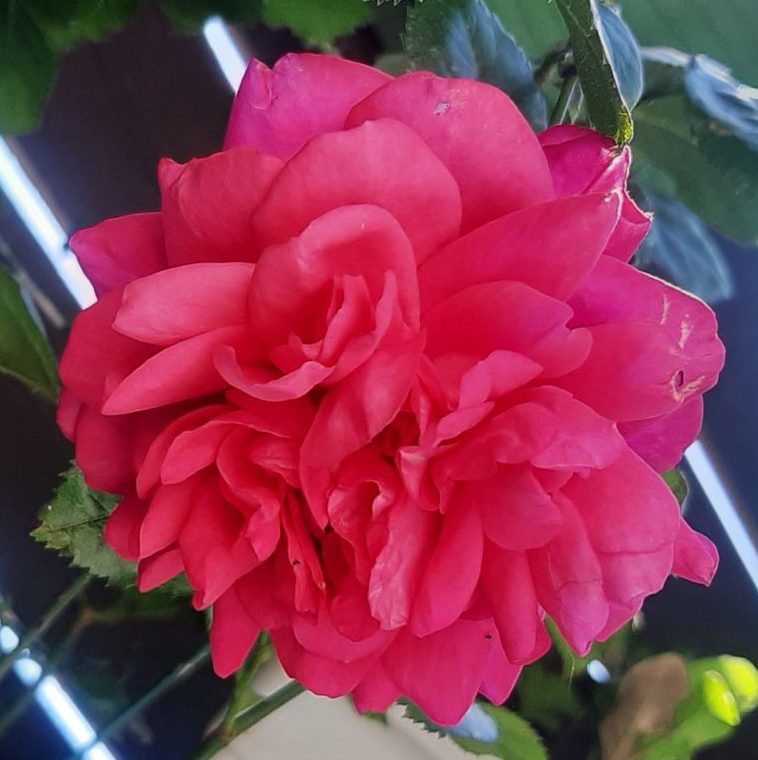
Then I realized the rose Lyle had bought for me shortly before he had developed leukemia and gone into hospital had finally come into bloom, and it was a bright pink rose of the Better Times variety. No coincidence, I thought.
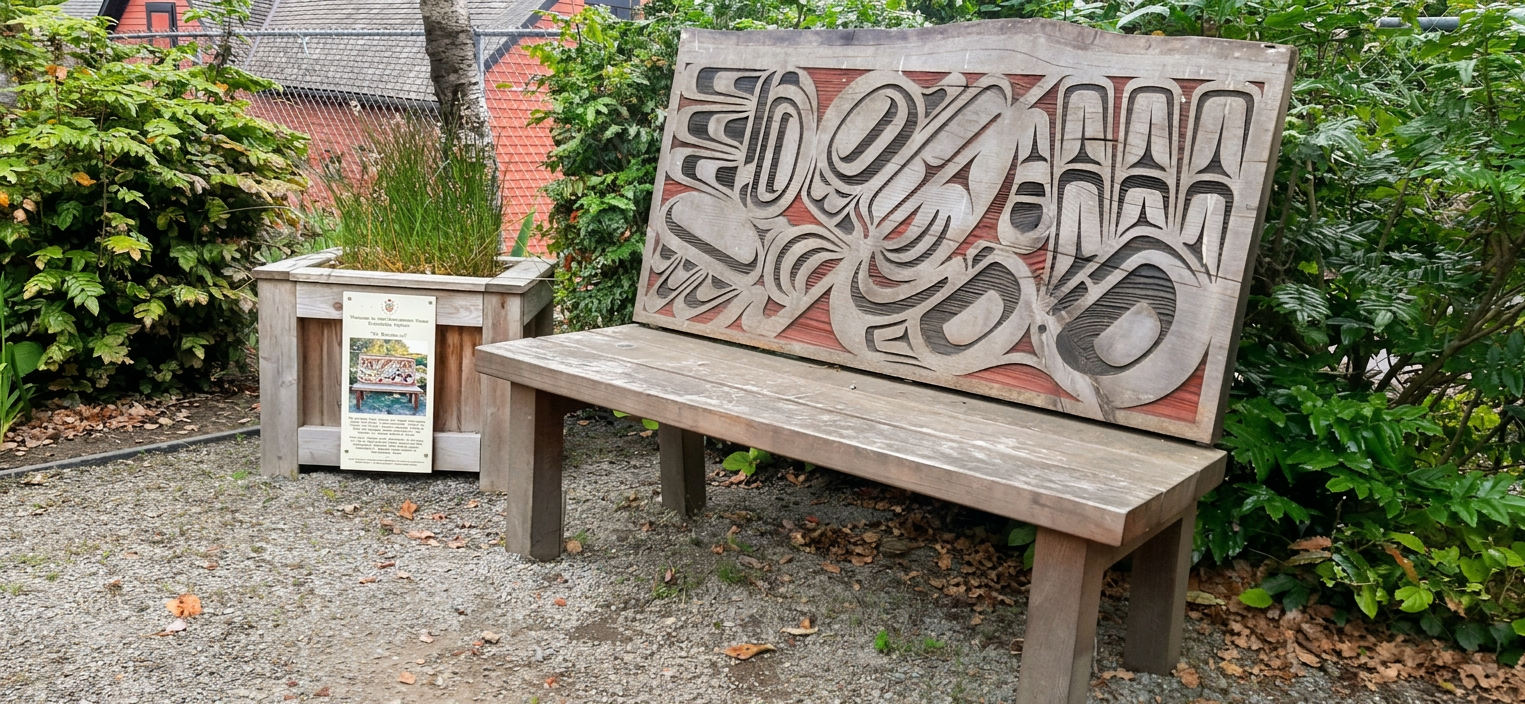
Then I went to see Shux-Shux and the Island at Open Space Gallery, an exhibition that the notes tell us: “…transforms the colonial space of Victoria back into a place of Indigenous thriving.” More Better Times. No coincidence – again.
And somewhere in all of that I wrote this. And it speaks of it all.
Spelling Out Colonialism
C is for Canada. We came here, settled here when I was a bab-ee. C is for Cree the most widely spoken Indigenous language on Turtle Island boasts 86,000 speakers. C is for (Plains) Cree, the dialect of the full status Indigenous man I loved, descended from shaman and hereditary chiefs – who signed the treaty that gave away their land – he was knowledge keeper and language carrier for his people.
O is for Origin. We originated in England – Great Britain – the greatest colonizers of all. Yes greater than France, greater than Spain, greater than the Dutch. The British Empire trolled the planet, and was the greatest in land mass, the greatest in population.
L is for Land, and Little did we know, we Landed on stolen land. It was the 1950’s, and our Dad – the Reverend Henry Boston, of Liverpool – admirable adventurer, courageous colonizer, exemplary explorer, and – it turned out – irreverent Reverend – brought his young wife and three young children to start a new life in the colony called Canada.
O is for Orange Order and Orange T-shirts – politics, religion and residential schools all twisted together. Orange the colour of sashes worn by British colonizer officers to show loyalty to the British Crown. And O is for the bright Orange shirt bought by her grandmother, then taken from Phylliss Webstad on her first day of residential school. And today, O is for the Orange shirts we wear on September 30th, so we will always remember the children torn from families to go get schooled in the colonist way, some who snuck out and died trying to get back home; some who never saw mâmâ and pâpā ever again, their graves only recently discovered, and yet denied by those who refuse to see, blinded by complicity.
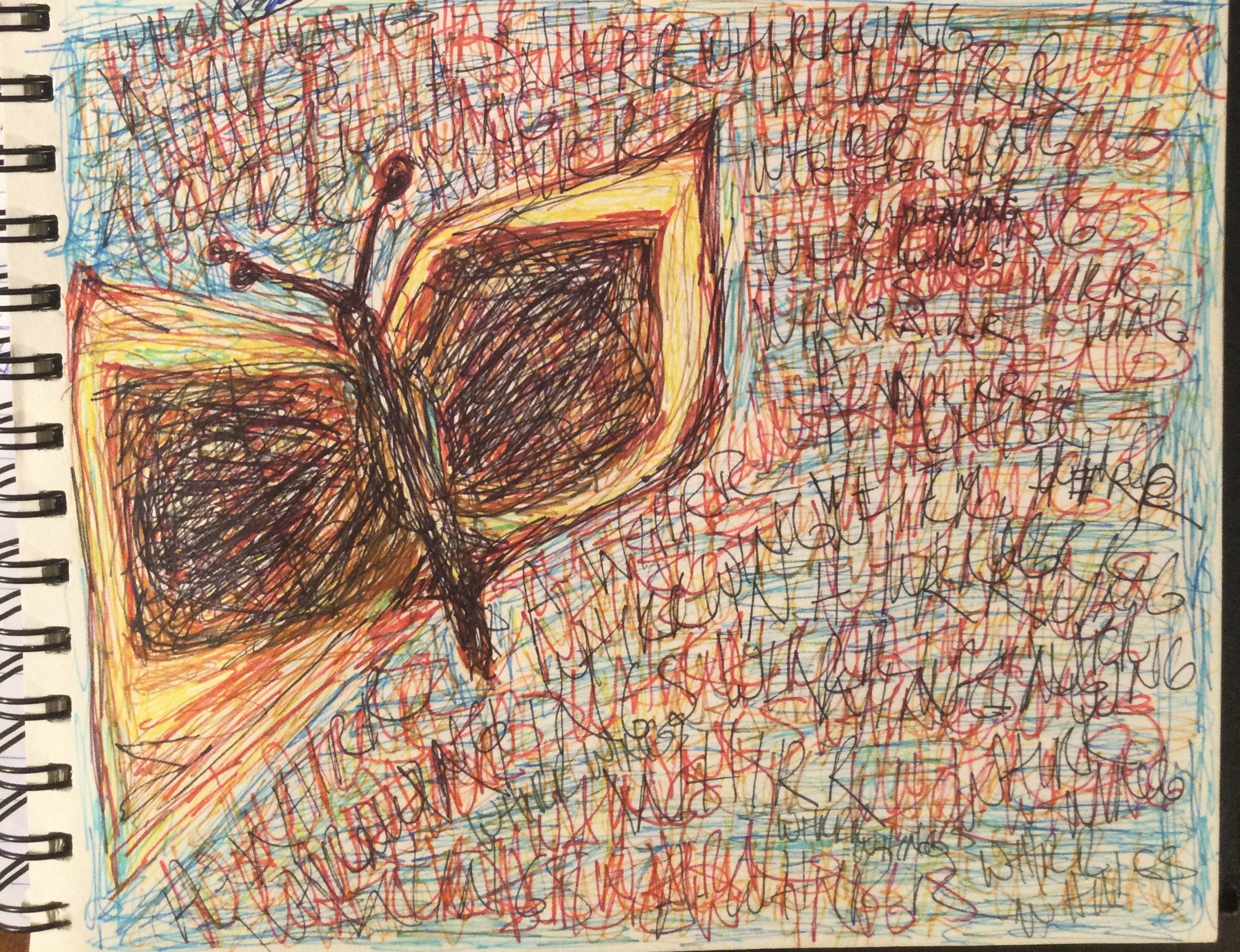
N is for Never. After just one year in Saint Michael’s Indian Residential School, Duck Lake, Saskatchewan Lyle swore he’d NEVER go back. After he passed over to the spirit world, to be with his ancestors, I found his hand-written testimony of abuses received, visions I can’t unsee, instilling a grief that seems at times it can’t be fixed, a grief so weighty it feels it can’t be carried, yet (re)borne it must be, and to be so, I and it must be like the caterpillar, sprout wings, and burst from the cocoon, fully transformed.
I is for Indigenous, the people who were here before the colonists arrived: yes the same ones the colonist priests and nuns and what-have-yous did all those unbearable, unnamable, unforgettable things to.
A is for Adapt, we kids were young and adaptable when we arrived in la Belle Province, while Mom – June – a British-speaking Londoner struggled to adapt to la petite village Valcartier; and the Indigenous, the Wendat Nation (Wendake-Nionwentsïo) whose territory we were in, probably never really adapted to the reserves the colonists corralled them on.
L is for Liberty and Living Life according to ancestral teachings. Living Life according to knowing, because it’s in your DNA. L is for the Liberty taken from Indigenous accused and incarcerated, some wrongly so, and disturbingly over-represented in the Canadian (in)justice system with a whopping 40% of the female inmate population* being women of Indigenous descent. …and L is for Lyle, the Plains Cree Man – wrongly accused and incarcerated, not once, but four times for the same crime – yet with whom I learned the true meaning of L is for Love, what we need to rise above…
I is for Identity, I identify as a white Colonial Settler woman, Lyle identified as a Plains Cree man, of One Arrow Territory, near Batoche, Saskatchewan and although we loved each other deeply, we also sometimes fought like two eagles, talon to talon.
S is for Settler & Stolen & Sixties Scoop. If you aren’t Indigenous, Settler is what you are on these lands that were occupied by, and yes, Stolen from another people who lived here before you or your ancestors arrived – if not taken by guns, then Stolen through trickery, lies and unmet agreements being compensated for today – and S is for Indigenous children Stolen from their families in the SS for Sixties Scoop. Lyle’s eldest sister was scooped, yet finally reunited, and with the passing of their mother, become the matriarch of her siblings.
M – is for More – More – More – Money – Murder – MMIWG2S+ – MooseHide Campaign – and Matwasinokeesik – take your pick – it was all done for More of everything Mostly Money, Land, Resources and Control. …and M is for Missing and Murdered Indigenous Women and Girls and 2 Spirited + remembered and celebrated with Red Dress Day and the Moose Hide Campaign …and don’t forget the Indigenous women sterilized unknowingly against their will, their future babies Murdered before they were even conceived…and finally, M is for Matwasinokeesik – Sounding Sky – Lyle Jacob John’s Cree name. Sound it loud, sound it clear, sound it like the sky is near, sound it so he can hear, know he is remembered and held dear Matwasinokeesik Matwasinokeesik Matwasinokeesik
*In the ten-year period between March 2009 and March 2018, the Indigenous inmate population increased by 42.8% compared to a less than 1% overall growth [in the total adult custodial population] during the same period. As of March 31, 2018, Indigenous inmates represented 28% of the total federal in-custody population while comprising just 4.3% of the Canadian population.Footnote5 The situation continues to worsen for Indigenous women. Over the last ten years, the number of Indigenous federally sentenced women increased by 60%, growing from 168 in March 2009 to 270 in March 2018. At the end of the reporting period, 40% of incarcerated women in Canada were of Indigenous ancestry. These numbers are distressing. (OCI, 2018: 61)
https://www.justice.gc.ca/eng/rp-pr/jr/oip-cjs/p3.html


Leave a comment